
.png)


Published: July 22, 2026 | By Jeff Ragsdale
Rural property can offer space, privacy and a different way of living. It can also shift several responsibilities from a municipality or utility to the owner. Water, septic, access and land-use questions may depend on records that were created by different offices, at different times, for different purposes.
The questions that most often make rural buyers pause are usually basic ones: Is there enough reliable water? What is known about the septic system? Is the access legally documented? Does the intended use fit the zoning? Were important improvements permitted? Can the property be insured and financed on acceptable terms?
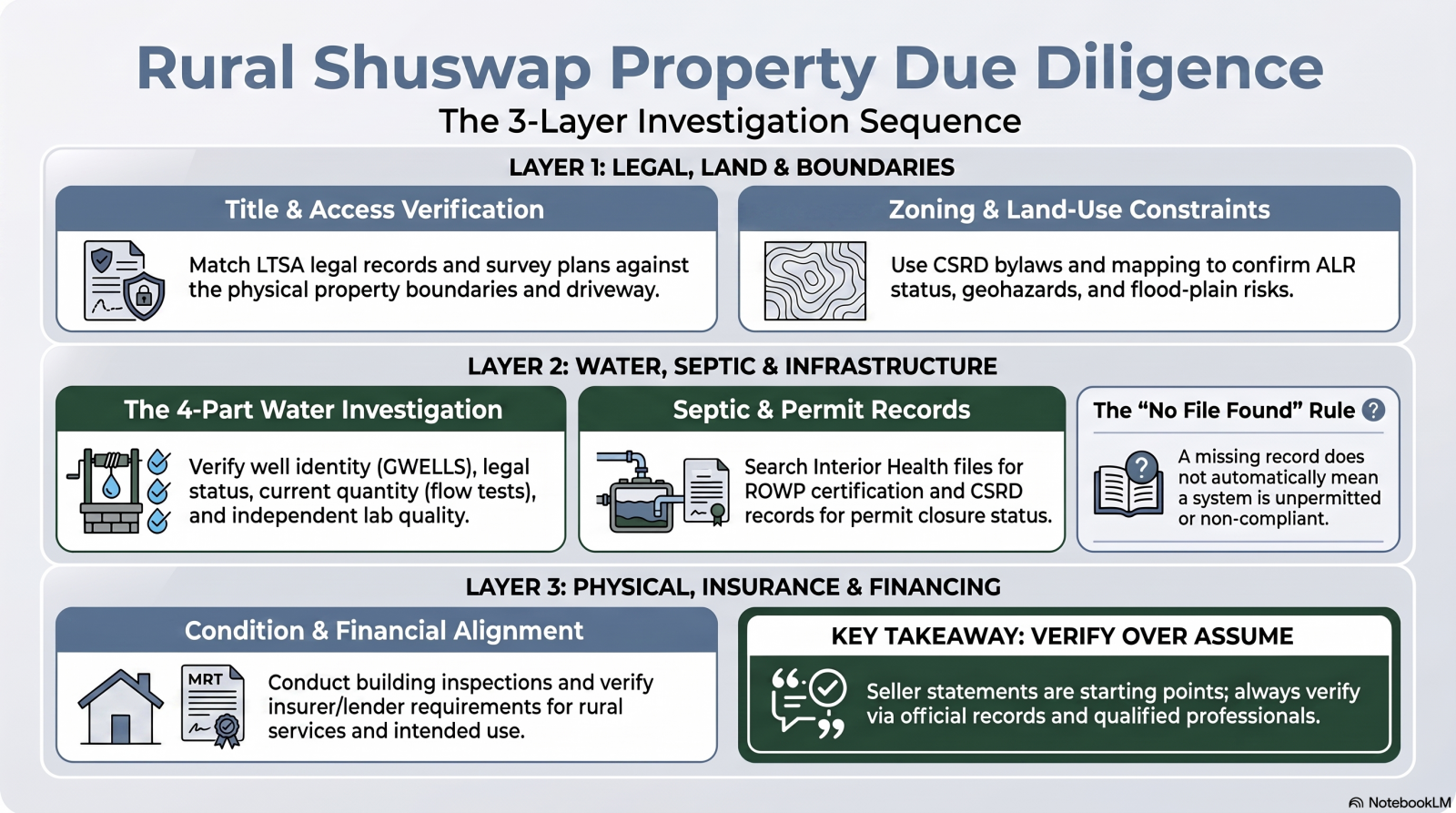
Those questions are connected. I help buyers organize them in a practical order, then route each unresolved issue to the authority or qualified professional who can answer it:
- title, access, zoning and mapped constraints;
- water, septic, servicing and permits; and
- building condition, insurance and financing.
This sequence is intended to surface larger constraints before a buyer commits heavily to detailed inspections or design work. It cannot guarantee that every issue will be identified early, but it gives the buyer a clearer way to decide what to investigate next.
Start with the buyer's intended use
A rural property should be reviewed against what the buyer actually wants to do with it. Living in the existing home may raise different questions than adding a suite, building a shop, keeping animals, operating a business, expanding an existing structure or creating another dwelling.
Write down the intended use before reviewing records. Identify whether water and sewer service are private, shared, or provided by a regulated or community system. Then ask whether title conditions, legal access, zoning, Agricultural Land Reserve status, development permit areas, servicing, permits, insurance and financing could affect that plan.
The Columbia Shuswap Regional District's online maps and land-use bylaws are useful starting points, but they are screening tools. Material land-use questions should be confirmed with CSRD Planning or the Agricultural Land Commission, as applicable. A lawyer or notary should advise on the effect of registered title documents.
Confirm the parcel, title and access
Begin with the correct parcel identifier and legal description. Civic addresses are useful for finding a property, but title and registered documents are tied to the legal parcel.
A visible driveway does not settle a legal-access question. The current title and underlying documents may identify easements, statutory rights of way, covenants or shared obligations. Those documents may need to be compared with the access that exists on the ground.
The Land Title and Survey Authority of British Columbia provides routes to current titles and registered documents and survey plans. A lawyer or notary should interpret legal rights and obligations. If the location of a boundary, driveway or possible encroachment matters, a BC land surveyor may be needed.
Useful questions include:
- Does the physical access match the legal documents?
- Is road maintenance shared, and is the arrangement documented?
- Do covenants or rights of way affect the intended use?
- Is an existing plan enough, or is field work by a surveyor required?
Check zoning, mapped constraints and permits
The zone name alone is not the answer. Buyers should identify the current zoning, Official Community Plan designation, development permit areas, ALR status and any mapped flood or geohazard context that may affect the property or intended use.
CSRD's online mapping application can help locate these records. Its online bylaws and maps are convenient working copies that may be amended, so a material question should be confirmed with the responsible department.
Permit history also needs context. A map may show some building-permit information, but a blank search result does not prove that work was unpermitted or that it complied. Records, service dates and exemptions can vary by location, project type and age.
If an addition, conversion, accessory building or other improvement matters to the decision, ask CSRD Building or Planning about:
- the permit number and description of the work;
- the issue date and inspection history;
- final or closure status;
- outstanding requirements; and
- available approved plans.
CSRD staff can address the administrative record. A home inspector, engineer or other qualified professional may be needed for physical condition or technical questions.
Treat a private well as four separate questions
A seller may describe a well as "good," but that does not answer every water question. Separate the review into four parts.
1. Identity
Does the physical well appear to correspond with the correct parcel and the available well record? Check the wellhead, identification details, seller-held documents and the Province's GWELLS registry where applicable.
GWELLS is useful, but registration was voluntary until February 29, 2016, and its records may contain incomplete, historical or data-quality issues. A missing result creates a question. It does not prove that no well exists.
2. Legal or administrative status
Well registration and water-use licensing are different matters. Ask what records apply to the source and the buyer's intended use. Property-specific questions may require the Province, a lawyer or a qualified water professional.
3. Quantity
Ask for available pumping or flow-test information, well construction details and any history of seasonal shortages. A historical driller's estimate is not the same as a current assessment of recovery, storage, seasonality and expected demand.
A registered well professional or an appropriately qualified professional with relevant hydrogeology expertise should address current quantity and sustainable-supply questions where they are material.
4. Quality
Ask for current independent laboratory results and follow the laboratory's sampling instructions. HealthLink BC's well-water guidance explains that one test describes the water quality on the day it was sampled.
A qualified laboratory should handle sampling and testing questions. Interior Health or HealthLink BC can provide health guidance. An appropriate treatment professional should address treatment options.
Separate septic records from present condition
First identify whether the property uses an onsite sewage system, a holding tank or a community service.
Seller-held records may include a filing or Record of Sewerage System, plans, a Letter of Certification, an as-built drawing, a maintenance plan, pump-out records, inspection reports, repairs and information about alterations or increased use.
Interior Health has a sewerage-file request process. Its current guidance warns that a search may not locate a file or may not produce an accurate diagram. "No file found" is therefore not a complete answer about whether a system exists, complies, works properly or can support the buyer's plans.
A filing or certification records an administrative step at a particular time. It is not a current warranty of condition, capacity or remaining life.
Where a septic opinion is needed, use the ASTTBC directory to confirm that the Registered Onsite Wastewater Practitioner or other qualified professional has current practising status and the endorsement appropriate to the work. Planning, installation, maintenance and private inspection are different scopes.
Bring insurance and financing into the review early
Ask the insurer and lender early what property information, tests, inspections or professional opinions they require. Give them accurate information about the services and intended use. Only they can confirm whether they will accept the property and on what terms.
A general home inspection still matters, but it does not replace title, zoning, survey, well, septic, permit, insurance or lending work. Each unresolved question should go to the office or professional qualified to answer it.
Seller statements are a starting point, not independent proof
Seller statements can be useful. They may identify where to look, what records to request, how a system has been used or what work was reportedly completed.
I explain that seller statements are useful starting information, not independent proof. Buyers should verify important matters through records, testing and the appropriate professional, such as the regional district, Interior Health, a lawyer or notary, a home inspector, a septic practitioner, a well contractor, an engineer, a surveyor, an insurer or a lender.
That does not mean assuming the seller is wrong. It means matching the importance of the decision to the quality and independence of the evidence.
When a record is missing or information conflicts
Avoid jumping from a gap to a conclusion. "No record found" is not automatically the same as "never existed," "not permitted" or "not compliant."
Work through the gap in order:
- Confirm the correct parcel, date, system or improvement.
- Ask what the seller holds and where that information came from.
- Check the relevant registry, map or authority-held file.
- Account for older registration practices, local service history and the scope of the search.
- Ask the responsible office or qualified professional to address what remains unresolved.
- Decide, with appropriate legal and professional advice, whether the uncertainty affects the offer, conditions, budget, timing or willingness to proceed.
The goal is to make the decision from the best property-specific evidence available, rather than from an assumption.
Who should confirm what?
| Question | Starting source | Property-specific confirmation may require |
|---|---|---|
| Parcel, title charges and legal access | LTSA title and registered documents | Lawyer or notary; BC land surveyor for boundary or location work |
| Zoning, development permits and intended use | CSRD maps, bylaws and Planning | CSRD Planning; ALC where applicable; legal or technical advice where needed |
| Building permits and administrative status | CSRD maps and departmental records | CSRD Building or Planning |
| Building condition | Seller records and physical inspection | Home inspector, engineer or appropriate trade |
| Well identity and records | Seller documents and GWELLS | Province; registered well professional; lawyer where rights are involved |
| Water quantity | Current property-specific testing | Registered well professional or appropriately qualified professional with relevant hydrogeology expertise |
| Water quality | Current independent laboratory testing | Laboratory, Interior Health or treatment professional |
| Septic records | Seller documents and Interior Health file | Interior Health; appropriately scoped ROWP or qualified professional |
| Insurance | Complete property and servicing information | Insurer or broker |
| Financing | Complete property, use and insurance information | Lender or mortgage broker |
A short rural-property review list
Before committing heavily to detailed investigations, identify the status of these questions:
- Correct parcel identifier and legal description
- Current title and relevant registered documents
- Physical and legal access
- Water and sewer service classified as private, shared, regulated or community service
- Intended use compared with zoning, OCP/DPA and ALR context
- Flood, steep-creek and other relevant mapped constraints screened and confirmed where material
- Well identity, records, current quantity evidence and current laboratory results
- Septic service type, seller records, Interior Health file, and current practising status and appropriate endorsement for any practitioner relied upon
- Material improvements compared with permit and departmental records
- Building, insurance and financing requirements
- Unknown or conflicting information, follow-up owner and deadline
Current official starting points
Sources accessed July 21, 2026:
- Province of BC: Buying or Selling Property that has a Water Well
- Province of BC: GWELLS
- HealthLink BC: Well Water Testing
- BC Sewerage System Regulation
- Interior Health: Sewerage, Subdivisions and Healthier Industries
- ASTTBC Registrant Directory
- CSRD Maps
- CSRD Zoning and Land Use Bylaws
- CSRD Building Regulation and Inspection
- LTSA: Search for a Title
- LTSA: Order a Document or Plan
- Agricultural Land Commission: ALR Maps
Have a rural-property question?
Considering a rural Shuswap property? Send Jeff the listing and explain which part of the property information is unclear. Jeff can help organize the questions and identify which records, offices or professionals may be relevant.
Use Jeff's contact form to send the public listing link and your question, or call 250-253-7991. Do not send inspection reports, title documents, test results or other private records through the public form.
This article provides general real-estate education, not legal, health, engineering, inspection, survey, insurance, lending, water-quality, water-quantity, onsite-sewage or regulatory advice. Requirements and records change. Confirm material property-specific matters with the responsible authority and appropriately qualified professional.

